
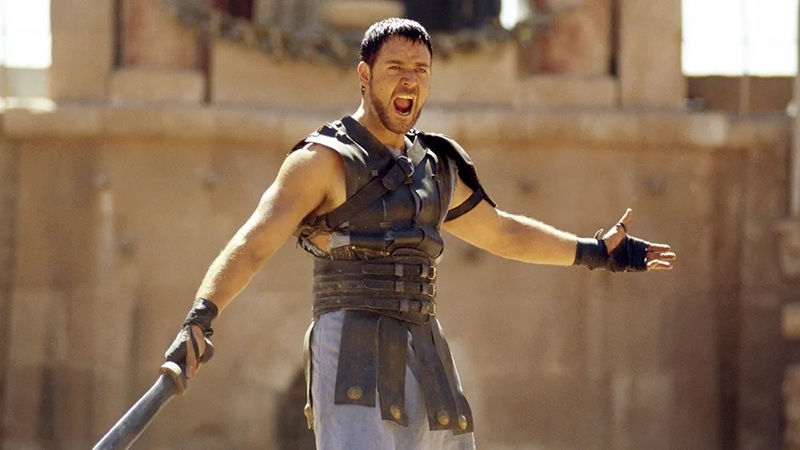
There’s a precise moment in Ridley Scott’s Gladiator that happens long before Maximus Decimus Meridius draws a sword in the Colosseum. He’s standing in the dirt, turning a handful of soil over in his palm. His eyes aren’t flashing with cinematic fury – they are glassy, heavy and infinitely tired. Before he even speaks a line of dialogue, you know everything about him: he’s a man who has already died inside, carrying a quiet, cast-iron grief that anchors his entire existence.
This is The Russell Crowe Effect – the art of anchoring a hero so deeply in melancholy that their nobility becomes a byproduct of their suffering, rather than a performative badge of honour.
For screenwriters, creating a “good guy” or a traditional hero in the modern landscape is notoriously difficult. Make them too pristine, and they feel insipid; make them too edgily cynical, and they cross into unearned antihero territory. By examining how master actors like Russell Crowe, Liev Schreiber, and rising indie talents channel a heavy emotional baseline, writers can discover a profound blueprint for crafting magnetic, complex protagonists.
1. The Anatomy of Emotional Weight
In script editing circles, there’s talk about a character’s “engine” – the internal motivation pushing them forward. But a melancholy hero doesn’t just have an engine; they have a anchor.
When an actor is given a role rooted in authentic melancholy, they aren’t just playing “sad.” They are playing a character whose worldview has been cast and molded by a specific, historical loss. When you write this baseline into your pages, you give the actor something invaluable: subtextual mass. The audience begins reading the performance before the character ever speaks. The hero’s sighs carry narrative weight. Their silence feels dangerous or tragic, rather than empty.
2. The Chivalry of Self-Denial
Why does an audience root so fiercely for a melancholy hero? Because their morality is tested by their apathy, yet they choose to act anyway.
A happy, well-adjusted hero does the right thing because it aligns with their bright outlook on the world. A melancholy hero does the right thing even when they feel the world is fundamentally broken and they have nothing left to gain. This creates a beautifully pure form of chivalry rooted in sacrificial love and self-denial.
When your protagonist is a “meat and potatoes” character who has been beaten up by life, their moments of tenderness or chivalry carry triple the emotional impact. If they deny themselves a romantic opportunity or a selfish pay out out of pure respect for another person’s vulnerability, it doesn’t feel cliché – it feels like a vital spark of light piercing through a dark shell.
3. Writing the “Incognito” Arc
The biggest mistake a writer can make with a melancholy protagonist is forcing them to “cheer up” by Act Three. A character anchored in grief doesn’t magically shed their trauma because the plot kicks into gear. Instead, their arc should be one of gradual discovery and psychological justification.
If your script requires your brooding hero to go from drinking heavily in a motel room to aggressively choking out a threat, you must give the actor the internal trajectory to bridge that gap. They must be allowed to slip up, look bitter and act out of deep-seated insecurity before they find their footing.
The transition shouldn’t be a sudden burst of confidence; it should be a reluctant awakening of their dormant warrior drive. They step up not because they want to be a superhero, but because they realize that while their own life feels stalled or done, they can still ensure someone else makes it out of the conflict alive.
4. The Screenwriter’s Checklist
To implement the Russell Crowe Effect in your next draft, run your protagonist through these foundational diagnostic questions:
Is the melancholy specific? Avoid vague, poetic sadness. Ensure your hero’s grief is tied to a concrete structural anchor – a career-ending injury, a fractured family lineage, or a specific, unhealed psychological wound.
Does their environment match their weight? Allow your character to look physically heavier, more exhausted, or distinctively unpolished in the early pages. Give them space to sit in their vice or their melancholy before forcing them into action.
Is their heroism quiet? Cut out any dialogue where the hero grandstands about their morals. Let their integrity be revealed purely through agonizing choices of self-sacrifice where they gain absolutely nothing but the quiet satisfaction of doing the right thing.
By anchoring your protagonist in the heavy, unvarnished reality of human suffering, you invite elite actors to bring their deepest vulnerabilities to the screen – and you guarantee an audience that will follow your hero straight into the colosseum.