
For two decades, South African film critic and script doctor Stephen “Spling” Aspeling has analysed stories from the outside in. Through ReviewMyScript.com, he has spent years helping screenwriters sharpen dialogue, fix pacing and salvage drifting third acts. But in an interview with Nkanyiso (NK) Ncube on CCFM’s Friday Night Synergy, Aspeling opened up about stepping to the other side of the desk as screenwriter and co-producer of the psychological thriller short Closer to Home.
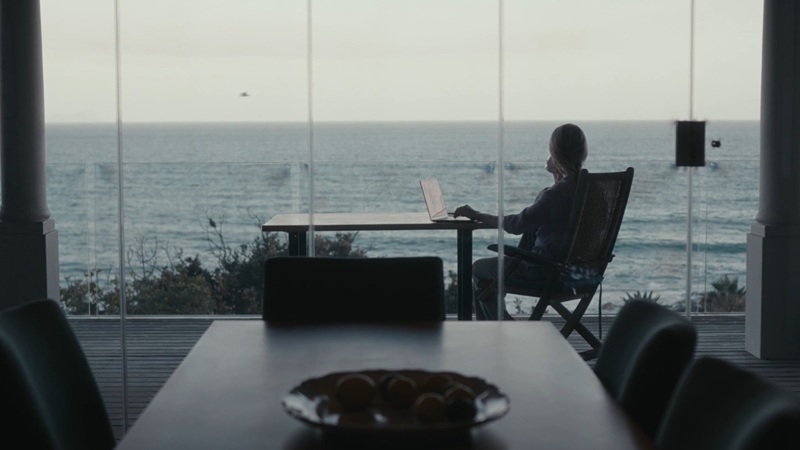
Directed and co-produced by Bekker-Brand Janse van Rensburg, Closer to Home follows an author named Ava who retreats to an isolated coastal village searching for healing and creative renewal. When a sudden revelation from her daughter disrupts her solitude, the boundary between external threat, trauma and memory begins to blur.
From Radio Drama to Proof-of-Concept
The project took an unconventional development path: before a single frame was captured on camera, the story proved itself in sound alone. Entering SAFM’s anonymously judged national playwriting competition, Aspeling’s audio drama version placed second out of 675 submissions nationwide.
“Up until that point, I had ReviewMyScript.com, working for a number of years just helping with other people’s projects. In the times where there was a little bit more time, I thought to myself, why don’t I create something? I had this feature film idea in mind, and the playwriting competition was the perfect opportunity to crystallise what I’d been working on… I can create an audio drama, and if it wins and is produced, suddenly you’ve got a produced work. You have something you can point to and say: ‘This won an award; you should take notice of it.'”
That radio foundation offered a sharp discipline: the narrative had to sustain tension purely through atmosphere, dialogue and sound design before translating into visual composition. Today, the completed short functions both as a standalone art-thriller and as a proof-of-concept intended to attract investors and collaborators for a full-length feature.
“The short film is basically the guts of the feature film. We have compartmentalised it to speak directly to the themes… You can run the risk with a short film of doing too much or sometimes too little, but we’ve tried to position it in such a way that it works as a standalone short. It’s beautifully shot, well acted, unconventional and has a distinct art-film feel.”
Writing Multi-Dimensional Characters
Casting the lead role was pivotal to balancing the story’s psychological weight. International South African actress Angelique Pretorius (Black Sails, Mind Thief, Spoorloos) stepped in as Ava, giving the protagonist a grounded resolve that avoids familiar genre clichés.
“The part of Ava is for a woman who is strong, and also able to have a very vulnerable side to her. I needed someone that was able to have that femininity, but also not take too much nonsense – to have that strength and that resolve… She kind of is beautifully seesawing in that respect. I didn’t want to have a woman in a classic slasher run-and-hide situation; I wanted that strength of character to come through.”
Script Doctor Insights: The Living Page
When asked about his philosophy on whether actors should deliver lines strictly verbatim, Aspeling stressed the necessity of creative freedom and organic delivery – a lesson every screenwriter should internalise.
“I do want a sense of ownership for that actor when they take on a role that I’ve written for them. I want them to actually embody that character – to be so invested that they’re thinking about wardrobe choices, thinking about how that character is going to say something. I’m not locked into a certain dialogue if it can be more organic, if there’s a better option, or if we can cut it down a bit.”
For writers working through their own drafts on ReviewMyScript, Aspeling left a vital piece of advice for refining scenes:
“When you’ve got your script together, read it out loud. Have a table read. Get some friends. Speak it out loud, because when you speak it, it sounds a lot different to how it looks on paper. Sometimes it just hits the ear wrong, and suddenly you realise: ‘Oh gosh, this isn’t sounding organic; it’s sounding a little bit robotic.’ It’s a great test.”
What’s Next for Close to Home
The film is currently circulating the festival circuit, targeting South African and international premieres ahead of planned public screenings and filmmaker Q&As in Cape Town. You can follow the film’s progress on /ClosetoHomeMovie on Instagram.