
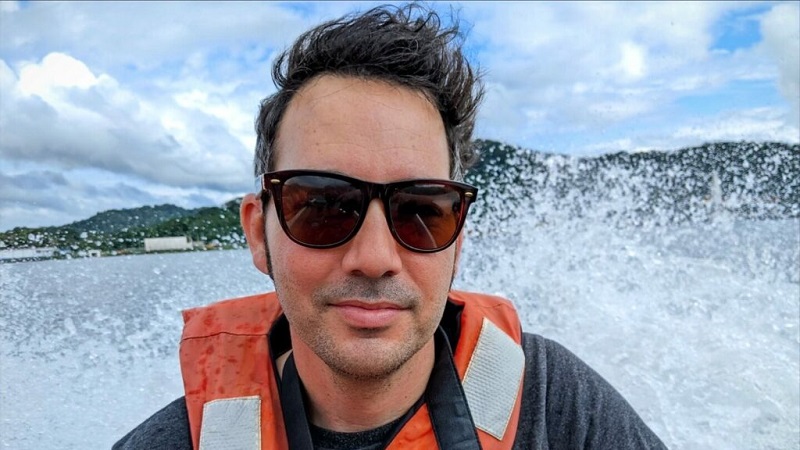
Every filmmaker seeks a lightning-rod moment, but for documentarian Ryan, the realisation of his calling was a slow-burn alignment of seemingly disparate worlds. In an expansive dialogue with reviewmyscript.com’s Stephen “Spling” Aspeling, Ryan Wirick traces a path that loops from recording skateboarders on oversized longboard wheels in Southern California, through a profound academic detour into philosophy, history and quantum physics, and back to the dirt of a regenerative farm.
The result of this circuitous journey is Farmacy of Light, a spiritual and scientific successor to his breakout documentary The Need to GROW. Co-written with long-time collaborator Rob Herring, Farmacy of Light isn’t just an exposé on our compromised food systems; it is a masterclass in the delicate art of non-fiction “connective tissue” – the cinematic architecture that turns technical data into human poetry.
Embracing the Narrative Pivot
In non-fiction storytelling, the most brilliant stories are rarely the ones you set out to tell. Ryan initially envisioned Farmacy of Light as a local, “run-and-gun” short about Erik, a charismatic, Clint Eastwood-esque regenerative farmer operating just an eight-minute drive from Ryan’s apartment.
Then came the narrative pivot: the dual disruption of a global pandemic and Ryan’s own deep-seated obsession with quantum biology.
“I think the universal need and craving in society is for people to reconnect with nature,” Ryan notes. “Everything feels divided, but everything is completely connected at the same time.”
By leaning into the philosophy of permaculture – specifically the idea of “access by proximity” – Ryan looked closely at what was right in front of him. When COVID-19 struck, shattering traditional filming schedules, the documentary morphed. It expanded from a local case study on Eric’s urban farming techniques into an ambitious exploration of biophoton emission, mitochondrial communication and cosmic light.
Instead of getting bogged down in “doom talk,” the chaotic arrival of 2020 became a structural catalyst. Ryan found archival footage of the late geneticist Dr Mae-Wan Ho, bringing her pioneering work on cellular light communication to the centre of a collaborative matrix alongside modern wellness voices like Dr Valencia Porter and Dr Zach Bush. The pandemic’s structural collapse was subverted into a message of immense hope, illustrating how Eric’s farm team partnered with local food banks to build resilient food systems on top of asphalt in a time of absolute crisis.
Splicing the Information Arc
The trickiest part of writing a documentary is ensuring the narration acts as an invisible, guiding hand. It cannot merely state facts; it must carry an information arc. Ryan explicitly treats his narration as a bridge: picking up where the experts leave off, transitioning through dense science and dropping the audience off safely into the next emotional beat.
To land this tonal balance – which seamlessly shifts from earthy, gritty farming practicalities to the ethereal narration of Hollywood actress and executive producer Evangeline Lilly – Ryan relied on a deeply iterative editing process. He would draft lines, temp-track his own voice over the score to test the “vibe” and pacing and continually refine the grammar on the fly during final recording sessions. The goal was to establish a profound scientific enquiry without isolating the casual viewer.
Radical Data Transparency: The Endnote Method
In an era deeply fractured by information bias and algorithmic echo chambers, documentarians bear a heavy burden of proof. Ryan’s approach to combatting skepticism is both refreshingly academic and radically transparent: The Endnote Method.
Harkening back to his days writing extensive academic papers in graduate school, Ryan integrated numbered endnotes directly into the film’s credits [1]. Rather than cluttering the screen with dense, distracting citations or resorting to theatrical, objective posturing, Farmacy of Light uses a clean numeric system on screen that points interested viewers straight to the raw data in the back.
Watch Farmacy of Light
This transparency is paramount when dealing with moving targets. Ryan recalls tracking the terrifying trajectory of chronic disease statistics in the United States over the course of the film’s production cycle. In early development, the baseline sat around 50% of Americans living with at least one chronic illness. By mid-production, that metric climbed to roughly 60%. By the time the film reached its final polish and launch preparation, the latest references indicated an alarming spike to roughly 74.5% [2].
By laying bare his mathematical reasoning and tracking these metrics transparently, Ryan bypasses the defensive walls of dogmatic skeptics. The film doesn’t attempt to invalidate chemistry or biology; it simply introduces a more fundamental quantum architecture underlying it all.
Beyond the 90-Minute Frame
Ultimately, Farmacy of Light is an invitation to step away from modernity’s hyper-fixation on the next ten minutes and return to a seasonal, generational relationship with time. For those ready to look past profit-driven institutional propaganda and explore our innate place in the living world, the documentary functions as a vital entry point.
And for the viewers who finish the 90-minute theatrical cut demanding to go deeper into the mechanics of quantum mycology, seasonal preparation and regenerative living? Ryan and Rob are already building the architecture for what follows: The Farmacy of Light Impact Kit, an expansive, multi-part video series designed to turn philosophical wonder into real, localised community transformation.
References & Endnotes
[1] Author’s Note: This conceptual technique effectively translates the rigorous accountability of scholarly literature into a visual medium, giving the audience the autonomy to audit the director’s investigative journey.
[2] Dynamic tracking data sourced from evolving public health updates collected between 2020 and production finalisation. Ryan notes that these figures demonstrate the baseline systemic failure of a symptom-management “disease care” paradigm versus a holistic, preventative system rooted in untainted food biology.